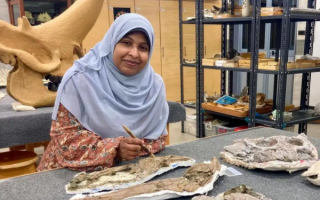
An Egyptian research team from Mansoura University announced the discovery of a new type of crocodile dating back to the dinosaur era, about 80 million years ago. The discovery was made in Egypt's Western Desert and was praised by officials in the higher education and scientific research sector, in appreciation of the scientific efforts made by the Vertebrate Paleontology Center team. The scientific team named the new species 'Vadosuchus kasabi,' which is the oldest member of the Dyrosauridae family; a marine family that survived the dinosaur extinction and thrived afterward. This discovery is a significant step in redrawing the evolutionary map of giant reptiles on planet Earth; it opens a new horizon for understanding the evolution of marine life during that era. Dr. Hisham Salam, a professor of vertebrate paleontology at Mansoura University, led the scientific team, which discovered the remains of 'Vadosuchus kasabi' in two areas in the Western Desert: the Kharga Oases and Paris in the New Valley Governorate. The excavations included parts of skulls and snouts of several crocodiles, belonging to four individuals in different life stages; this reflects important environmental and historical diversity. Dr. Salam noted that this discovery marks a milestone in the history of Egyptian paleontology, confirming that it helps to shed light on the treasures of the Western Desert, which hold secrets from ancient eras. The research team used 3D CT scanning techniques to reveal detailed anatomical features. The 3D scanning aided in the reconstruction of the skull, which revealed transitional features that illustrate the flexibility of reptiles in adapting to environmental changes.