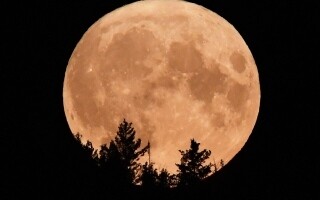
In a captivating celestial spectacle, the 'Butterfly Moon' will illuminate the sky of the Arab region tonight, presenting a stunning view that combines the clarity of the moon with the breath of spring. When it appears near the eastern horizon after sunset, the 'Butterfly Moon' appears larger in size and may take on a reddish or orange hue. This is due to its light passing through a thicker layer of the Earth's atmosphere, where short blue light waves scatter, leaving the long red ones. This is the same reason why the sun appears red at sunrise or sunset. The moon gradually rises in the sky during the evening, reaching its highest point around midnight, and then begins to descend towards the western horizon. According to Egypt's National Institute of Astronomical Research, the moon enters its full moon phase when it is in opposition to the sun relative to the Earth, with the side facing us fully illuminated. The exact moment of fullness occurs when the angle between the sun, Earth, and moon is 180 degrees. This phase is suitable for photographing the moon's disk, and some craters with bright rays become more prominent. However, the near-vertical lighting during the full moon reduces the length of shadows, making most terrain and fine topographical details less pronounced compared to the new moon or quarter phases.