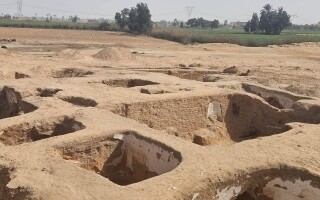
The Egyptian Ministry of Tourism and Antiquities announced the success of the Egyptian archaeological mission, working in the area of El-Rabaiyat in El-Qalya region, affiliated to Hush Issa Center in Beheira Governorate. The mission has uncovered a historical building that is likely to have been used as a guest house during the early period of Coptic monasticism, dating back to the 5th century AD. According to a statement issued today, the works revealed a number of architectural elements added to the building in later historical phases, reflecting the evolution of its use over consecutive time periods. Dr. Hisham El-Lithi, Secretary-General of the Supreme Council of Antiquities of Egypt, stated that this discovery is an important scientific addition to the study of the evolution of early monastic architecture in Egypt, noting that the El-Qalya area is the second largest monastic gathering in the history of Christian monasticism, and its architectural style reflects the nucleus for the founding of monasteries. He pointed out that the discovered decorations and paintings are among the most important sources for studying early Coptic art in Egypt, as they carry historical and archaeological connotations that shed light on the nature of monastic life and the development of arts in their early stages. Dr. El-Lithi explained that this discovery clearly highlights the development of simple monastic architecture and shows the functional evolution from the individual cell to semi-communal housing patterns, up to facilities designated for receiving visitors, whether senior fathers of monasticism or those wishing to join monastic life, as well as other visitors. Dr. Diaa Zahran, Head of the Islamic and Coptic Antiquities Sector at the Supreme Council of Antiquities, said that the discovered building consists of 13 multi-functional rooms, including rooms for the individual and collective accommodation of monks, as well as rooms designated for hospitality and education. These are spacious rooms divided by architectural vaults, in addition to service facilities that include a kitchen and storerooms. He also pointed out that in the northern part of the building, a large hall was discovered that includes distinctive architectural elements, including decorated stone benches with plant motifs, which are likely to have been used to receive visitors and provide them with services. The building is centered by a place for prayer (eastern), which is dominated by an apse preceded by a limestone cross on its eastern wall, and the building extends along its axis from north to south. Meanwhile, Samir Rizk Abdel Hafez, head of the mission and General Director of Antiquities in Beheira, stated that the excavation works led to the discovery of a number of mural paintings representing incomplete scenes of monastic figures, identified by their clothes, in addition to various plant decorations, including a braid in red, white, and black colors, and an eight-petaled flower. According to the statement, a mural was discovered depicting two gazelles surrounded by plant decorations, with a double circular shape in the middle containing an internal plant decoration, in an artistic model that reflects the richness of symbolic expression in early Coptic art. The mission was also able to find a complete marble column two meters long, in addition to column capitals and bases, pottery vessels, and a large number of pottery sherds, some of which bear plant and geometric decorations, while others include Coptic letters, while some pieces are free of decorations or writings.