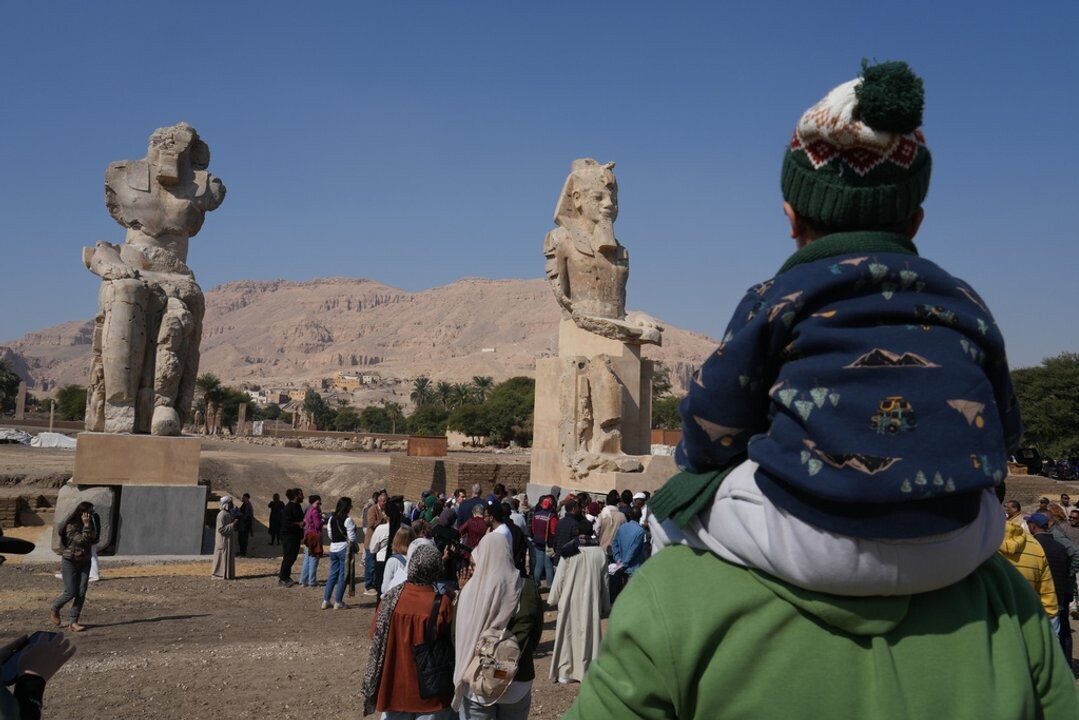
Egypt revealed this Sunday two colossal alabaster statues of Pharaoh Amenhotep III from the 18th Dynasty, which have been reinstated in their original location after over two decades of restoration work, the Ministry of Tourism and Antiquities reported. The sculptures, standing between 13.6 and 14.5 meters tall, were placed at the third pylon of the king's mortuary temple on the west bank of Luxor, a few meters from the famous Colossi of Memnon. These are two seated figures of the pharaoh, who ruled approximately from 1390 to 1353 BC, during one of the most prosperous periods of Ancient Egypt. The statues had been found at the same site in the form of scattered fragments and in an advanced state of deterioration due to sedimentation and the prolonged action of saltwater that covered them for centuries. In 2006, an international team embarked on an ambitious project of cleaning, documentation, and restoration, which included 3D scanning and the reassembly of hundreds of original blocks. As explained by the Secretary-General of the Supreme Council of Antiquities, Mohamed Ismail Khaled, the work was carried out “according to the latest scientific methods and international standards adopted in the field of archaeological restoration.” The final lifting and repositioning of the statues were completed in 2025. The project also allowed for the recovery of several granite blocks belonging to the original bases of the sculptures, sourced from the open-air museum of the Karnak temples. During the excavations, archaeologists also found and restored some 280 statues and fragments of the lion-headed goddess Sekhmet, awaiting exhibition in the temple's colonnade. Likewise, two limestone sphinxes were discovered, which are currently in the process of restoration as part of a comprehensive plan for the management and protection of the archaeological site.